The long conflict that took roughly fourteen years (2011–2024) in Syria has ruined Syria's energy industry and, therefore, economical state. The post-Assad government faces a huge bill and reconstruction tasks as the UN estimated war damages at hundreds of billions and is aggressively looking for investment, especially in energy.
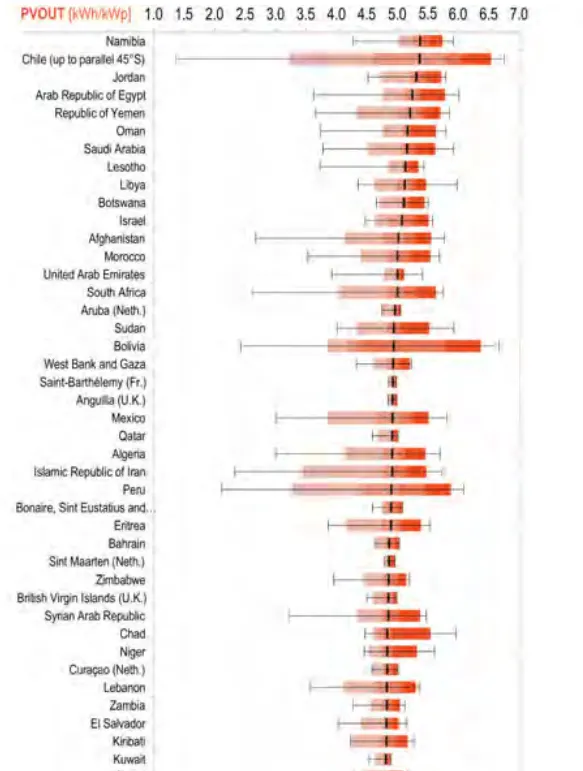
As a good opportunity for Syria to build the energy production, renewables (especially solar and wind) offer one of the most promising paths. Studies indicate that solar exposure and wind speeds are among the world's highest in Syria, as one assessment estimated a technical solar potential of 55,265 TWh/year (Ramadan & Elistradov, 2018).
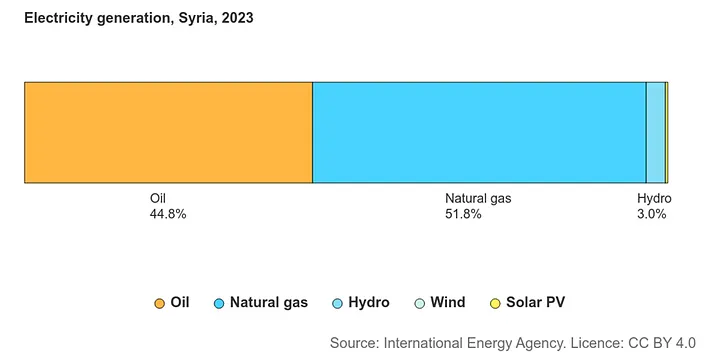
However, in Syria, the main source of electricity production remains natural gas. Shifting toward renewables would require not just physical reconstruction, but a whole-system transformation — new regulations, financing mechanisms, and workforce adaptation. As of 2023, Syria's installed solar capacity was only about 60 MW.
1. Qatar
In May 2025, Syria signed a $7 billion agreement with a consortium led by Qatar's UCC Holdings to handle its power sector. This agreement includes four combined cycle gas turbines (~4,000 MW) and a 1,000 MW solar farm. Its goal is to double capacity and cover roughly half of demand.
2. Saudi Arabia
In September 2025, the Syrian Energy Ministry and Saudi ACWA Power signed a Joint Development Agreement to explore ~2.5 GW of new renewables — 1 GW of photovoltaic and 1.5 GW of wind capacity with grid-scale storage, plus a technical and training center.
3. Türkiye
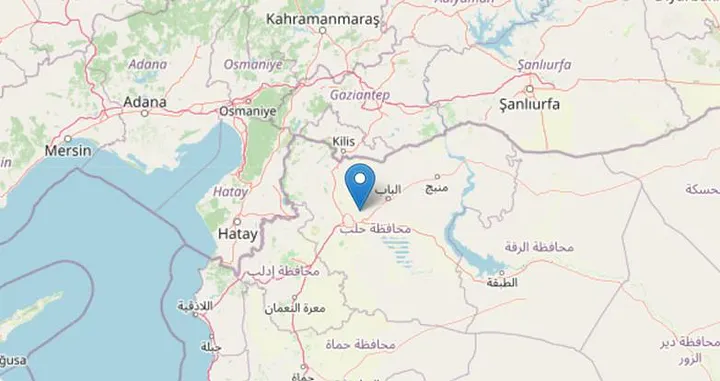
Türkiye's role includes a $7 billion MoU led by UCC with Kalyon, Cengiz, and Power International, planning approximately 5 GW — four gas CCGT units (~4 GW) and a 1 GW solar. The Kilis-Aleppo gas link was reactivated via a BOTAŞ-SOCAR swap (2 bcm/year). Cross-border electricity is scaling from 210 MW toward 900–1,000 MW by 2026.
4. United Arab Emirates
In 2025, Syria launched a UAE partnership to build a 300 MW solar plant as part of a broader $7 billion energy deal — "the first of several planned solar and wind facilities" totaling approximately 3,000 MW. This project also includes fixing damaged thermal plants and grid upgrades.
Renewable installations create jobs in construction, operations, and maintenance, which is crucial to solve Syria's high unemployment. They also promise savings on fuel imports. A large solar farm can generate electricity cheaply at marginal cost zero, which would relocate expensive diesel or gas.
According to The World Bank's Syria Damage Assessment of 2022, total damage across cities and sectors was around $9 billion. The multiplier effect of infrastructure investment is actually high. Every single dollar spent on construction would bring GDP growth over time.
Syria's energy rebuild is now shaped by economic and practical moves. The $7 billion package, Türkiye's gas and power links, and ACWA's renewables MoU show the near-term recipe: gas to restore baseload quickly, solar and wind to start lowering costs and diversifying supply. These projects can turn quick fixes into durable gains.
References
- Alsayed, G., & Chehayeb, K. (2025). Syria looks to solar power. The Independent.
- RAMADAN, Ibrahim; ELISTRATOV, Viktor. Evaluation of solar energy potential in Syria. IEEE, 2018.
- Reuters (2025), ACWA Power (2025), The World Bank (2020/2022), IEA (2025).